
In one way or another, whether because our professional responsibilities are tied to the analysis and/or development of marketing strategies in the digital channel, because we consider ourselves avid explorers of the topic, or simply because we find ourselves in an increasingly interconnected and decidedly virtual context of needs satisfaction, we have become deeply aware of the importance that online purchasing methods have acquired in our daily lives.
It is no longer a radical discovery, in terms of understanding modern marketing dynamics, that today we can acquire practically all manufactured products and services offered on the market digitally. According to Statista, global digital advertising spending alone has grown from $243 billion in 2017 to $680 billion in 2023 (an increase of around 180%), with projections to reach over $910 billion by 2027, representing an increase of more than 270% in just one decade.
Digital technology has invaded our lives without asking our permission or giving us any choice. The way we interact with people, obtain information, travel, manage household tasks, exercise, entertain ourselves, and countless other activities have been transformed by the virtual world. Why shouldn’t the same happen with how we acquire goods and services? Digital technology has triggered the construction of a “new everyday life” for individuals, fueled by the decreasing cost of access to desktop devices and the expansion of digital devices across all social strata, enabling connectivity, immediate access, and valuable data availability.
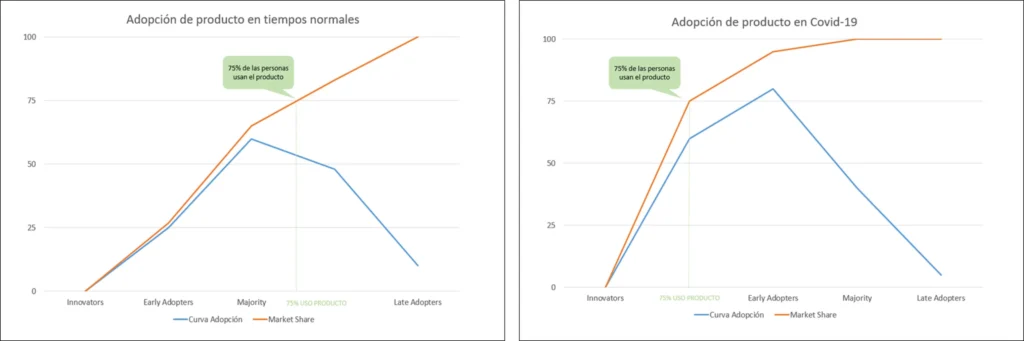
In this context, and according to the Argentine Chamber of Electronic Commerce (CACE), currently 9 out of 10 Argentinians have already made an online purchase at some point, with the largest segment (67%) being between 18 and 49 years old. In the first half of 2023 (the latest data available from the chamber), 15% of total company sales were conducted through digital channels, with the expectation that by 2025 this share could reach nearly 18%. The recent pandemic, with its forced confinement in a world of predominantly virtual connection and consumption, has helped to exponentially accelerate these digital consumption patterns. As part of her contribution to the seminar “next:Work – A Four Week Digital Event Series on the Changing Jobs, Careers and Workforce for the Future,” organized by Singularity University, Nell Watson (a renowned technologist and AI specialist) shared a significant piece of data to understand the impact of the recent health crisis: while in pre-pandemic times products reached 75% penetration (population usage) at or just slightly later than what the well-known product adoption curve would typically indicate as “adoption by the majority,” during the pandemic, that 75% was reached earlier than what would normally have been the “early adoption” stage. As Watson herself states, “the digitalization forced by the coronavirus brought the promised future to the here and now, faster.”
The digital transformation of our lives has, as expected, had a profound impact on business, pushing companies to adopt technological changes that focus on the customer and new technologies. Participating in the digital world with a solid value proposition is no longer an option but rather a mandate that companies must accept, regardless of their market or size, and on which they must place their focus. But in the course of this new process of thinking and execution that comes with participating in a channel with the relevance and potential of the digital world, a series of questions arise that often keep companies (especially small and medium-sized ones) awake at night: What do I do with my physical stores? Is the internet going to kill my long-established business? Isn’t this just a passing fad? In seconds, what seemed like a great opportunity transforms into a very difficult puzzle to solve and very dangerous for the business’s status quo.
What the data seems to indicate is that in markets where e-commerce has gained prominence, traditional brick-and-mortar retail has continued to grow. When analyzing the estimated evolution of retail sales and their online/offline mix globally over the last eight years (2015-2023), e-commerce’s share of total retail sales has grown by almost 10 percentage points, but combined sales (physical + digital) have increased by approximately $11 trillion. Clearly, e-commerce has not only failed to kill brick-and-mortar stores, but has actually boosted and strengthened them.
We only need to recall some of the moves by major retailers to consolidate their physical and digital businesses. Here are a few examples.
In 2018, Amazon acquired Whole Foods, the world’s leading organic food retailer, to establish its presence in the physical retail channel. That same year, it also realized one of its major business projects: the opening of its first cashierless store in the United States (Amazon Go). Walmart responded to these moves with a mega-strategic alliance with Google through Google Express, the Mountain View giant’s shopping assistance service, and the acquisition of the online retailer jet.com for $3.3 billion. Alibaba (a major competitor of both and the dominant digital retailer in Asia) acquired the Sun Art supermarket chain (a leading brick-and-mortar retailer in China) in 2017, while Mercado Libre partnered with 20,000 small and medium-sized Mexican businesses to sell iconic products from each region of the country through its sales platform. The examples could be countless: jd.com (another major Chinese e-commerce chain), partnering in 2020 with Fung Group to incorporate 3,200 physical points of sale, or Puma (the renowned sportswear brand) launching in 2020 its strategy of intertwining its online channel, distributors and physical stores in a macro-universe of customer touchpoints.
My intention is not to bore you with a long list of references, as I could continue describing these kinds of intersections between physical and digital sales for countless pages. What I want to highlight is the complementarity that both channels are developing, due to the simple, natural dynamic of mutual reinforcement they have found in response to a mode of purchasing and consumption that is, in turn, part of a much larger and more encompassing cultural shift brought about by the rise of virtuality. We must decode the characteristics of this dynamic and extract lessons that allow us to boost the company’s business, regardless of its market, the type of customer, or the scale of the operation. The secret is to identify the opportunity in what may initially seem threatening or difficult to understand. As Tim Cook, CEO of Apple, once pointed out: “You can focus on the barriers, or you can climb the wall and redefine the problem.”
Technology, and especially digital tools, have facilitated the current consumer trend toward functionality, which is defined by getting what you want, when you want it, how you want it, and where you want it. Functionality defines a convenience that demands much more than a simple “good price”; it’s the consumer demand for solutions that help simplify their lives, regardless of who provides them or where. Consumers don’t see channels, they don’t dwell on operational problems a company might have, however debilitating they may be; they only see a product or brand they want to buy. This has led to a blurring of marketing channels, where the existing barriers between them have disappeared, their boundaries becoming unclear or confusing for individuals. Just think of this example: you’ve surely noticed the small shops at each of the countless gas stations you’ve visited; you most likely went into them before or after filling up your tank. How would you define that place? Is it a coffee shop? A kiosk? A mini-market? A beverage store? A payment center? It’s a tough decision, isn’t it?
No matter the time, the place, the weather, the distance, or any physical obstacle, the consumer just wants their product, and they want it right now. Consumers have evolved toward a more extreme individualism when thinking about and making purchases, seeking new experiences, personalization, and satisfaction, desiring an emotional connection with the brand through a differentiated experience, and that emotional connection must occur across all platforms and channels. Consumers expect an integration of product and service offerings (physical branches, the internet, and mobile devices) to assist them in a useful, personalized, and frictionless experience. They need the offering to be functional to their needs.
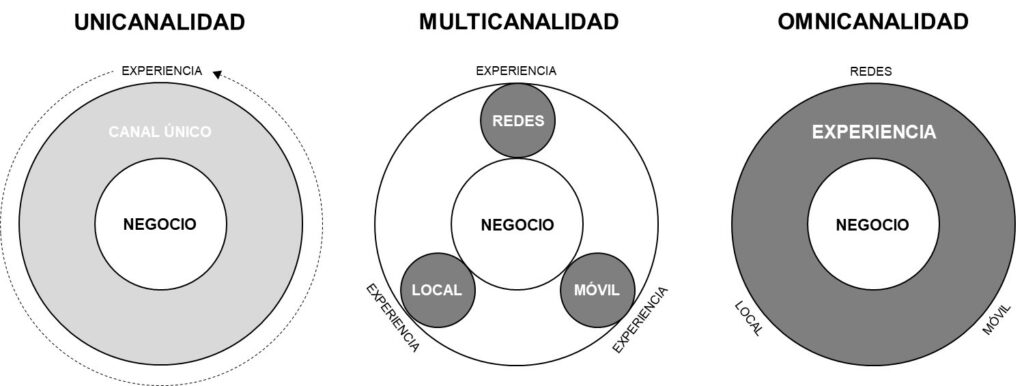
At this point, the roles of the physical and digital channels don’t seem to differ in their essence. Beyond the different strategies each company may adopt and the specific objectives they design for each channel, the offline and online offerings must provide the same satisfying shopping experience that customers desire. This is the fundamental role; the channels become tools serving a primary and specific objective: placing the customer experience at the heart of the business. This not only affects the old concept of single-channel (recognizing operational strength in a single channel and directing customers there), but also multichannel (operating across different channels with unconnected, specific strategies for each, focusing solely on the coverage of the offering). This superior conceptual evolution has led us to omnichannel, and the best definition to date comes from Frost & Sullivan, a consulting firm specializing in this area, who defined it as “high-quality, seamless, and effortless customer experiences that occur across and within touch channels.” The consumer has definitively taken control.
There are sectors that have experienced sustained progress in omnichannel strategies, primarily driven by large corporations. To cite just a few examples, and without aiming to be exhaustive, there’s the banking sector, with the aggressive emergence and growth of online banking and various digital financial instruments; the clothing and fashion sector, with the incorporation of virtual fitting rooms to improve the try-on and personalization of garments; the art exhibition sector, with the efforts of major museums to develop virtual tours and related activities in response to the pandemic; the automotive industry, with the widespread adoption of virtual drive tests and concept stores; and the aforementioned diversification of large retailers (both digital and physical) across a wide range of customer touchpoints. We could continue with many more examples. This trend is rapidly evolving, and we, as companies, must adapt to it.
To wrap things up and offer something more than a simple descriptive summary of the changes in purchasing behavior, the impact of digital technology on marketing channels, and the resulting role adjustments, I’d like to share a couple of proactive messages for those who haven’t yet embraced omnichannel retailing: one regarding the elements to consider when starting this journey, and finally, a reflection on this challenge within the context of smaller businesses.
Regarding the first point, we must begin by diagnosing “where omnichannel falls short” (Are we providing the exact same experience to our customers at every touchpoint? Where are we failing? What are the priorities for immediate improvement to foster customer loyalty? Are we present in all the places where our customers seek us out?). Based on this diagnosis, we must begin to redesign the omnichannel strategy, defining the tools to use in each case to spark consumer interest, facilitate product and/or service exploration, streamline the purchasing process, ensure the expected consumer experience, and encourage recommendations. Interest + Exploration + Purchase + Consumption + Recommendation: these are the crucial variables to address in an omnichannel plan.
Finally, I would like to dedicate a paragraph to small and medium-sized enterprises (SMEs) to contribute to dispelling the myth that omnichannel strategies are only for large organizations with sufficient investment resources. I would like to offer a brief reflection here.
Omnichannel is a concept, a way of thinking about marketing, a philosophy that places the customer at the center of the equation and makes them the heart of the business. It’s a concept that doesn’t refer to monetary or temporal dimensions, but simply to a dimension of understanding reality (like Robinson Crusoe and his raft, versus a huge transatlantic ship). With our everyday tools and our financial resources, we have the same possibilities to do what we’ve always done or to make small changes that, in the long run, produce exponential growth. If we own a small neighborhood business, we can learn how to market on social media; if our business is large but analog, digital will be an opportunity for diversification; if our business is entirely digital, we will surely find additional physical ways to contact our customers that don’t necessarily involve formidable investments. But all of this must be under the sacred mantra: ensuring the same customer experience at every point of contact.
We are facing a paradigm shift that is continuously and rapidly challenging our way of doing business, without making any distinctions. It’s simply there, urging us to reconsider our framework of thought. Peter Drucker wrote, “The greatest danger in times of turbulence is not the turbulence itself, but acting with the same logic as before.”
Fernando Sierra
Founder & Executive Partner
Salesciology